cell
Neutrophil
Short-lived innate responder that converts danger gradients into oxidative and proteolytic containment
Review layer
Last reviewed 2026-05-17
Systems teaching draft. Content is structured for education and graph expansion, with formal source tagging ready for the next review pass.
Provenance layer
External context
Curated external IDs add pathway and protein context around Atlas content. They do not update the graph automatically and they are not patient-specific interpretation.
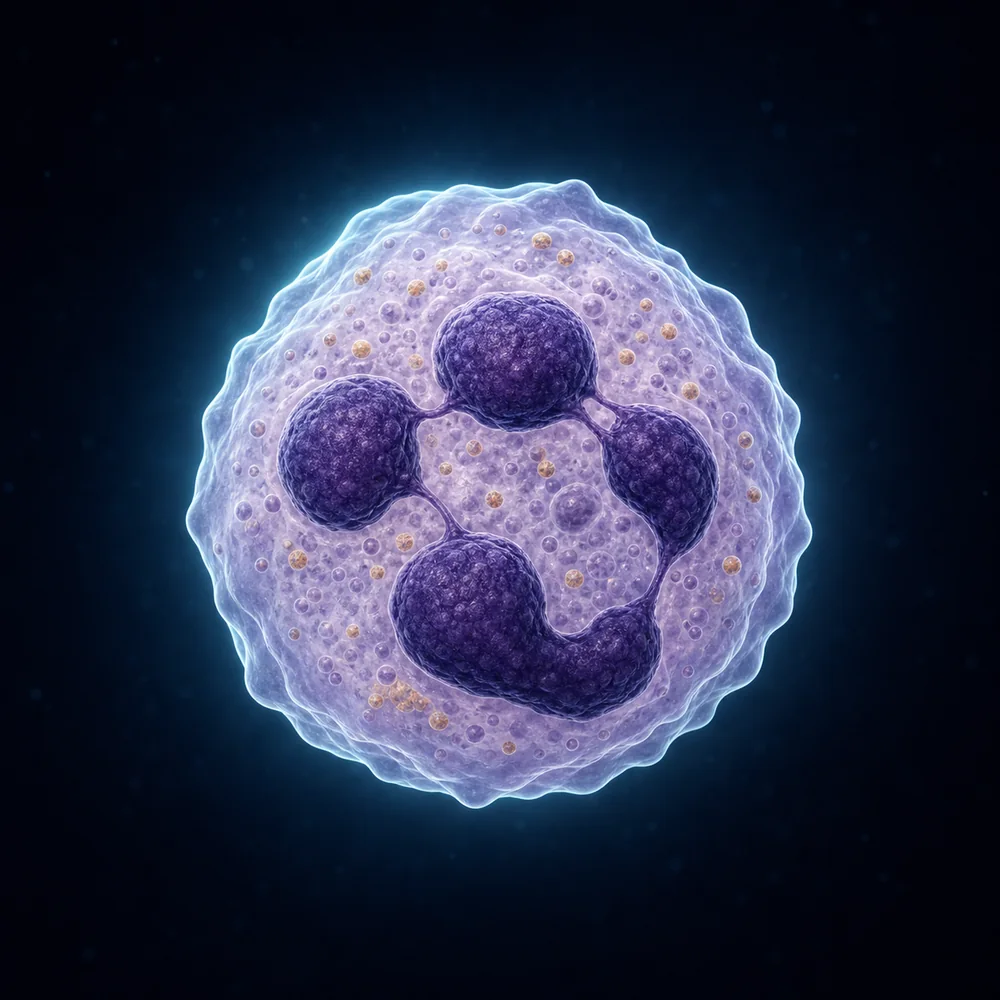 Educational illustration · not microscopy
Visual specimen
Neutrophil specimen
A short-lived innate responder identified by its segmented nucleus and fine antimicrobial granules.
Look for
- Segmented multilobed nucleus
- Fine cytoplasmic granules
- Intact resting-to-ready membrane
Illustration, not microscopy. Granules and chromatin are emphasized for recognition and are not to scale.
OpenAI-generated educational illustration under Atlas editorial direction · 2026-07-12
State signature
Systems profile
System effects
Primary mapped axes from existing Atlas data.
Inflammation
Inflammatory alarm, recruitment, mediator release, or tissue-damaging amplification.
Tolerance
Immune restraint, resolution, regulatory tone, or set-point control.
Chronicity
Memory, priming, fibrosis, exhaustion, remodeling, or other time-dependent drift.
No direct axis cue is mapped for this node yet.
Local map
Relationship field
Arrows point from the upstream source toward the receiving target. Restraint edges use a bar; association edges stay dashed because they are not causal arrows.
Selected relationship
Neutrophil-rich inflammation often co-travels with IL-6 tone
Read as a non-causal co-traveling relationship unless a reviewed edge says otherwise.
What this relationship means
Read this as Neutrophil and IL-6 traveling in the same context, not as proof that one causes the other.
Effect of source
Neutrophil helps name the context or upstream layer to inspect.
Effect on target
IL-6 is a related node to compare for shared tissue, timing, or mediator signals.
Use with caution
Association edges are hypothesis and teaching context, not causal claims.
System effect
Neutrophil and IL-6 are shown as a co-traveling context; use the axes below to see which mapped systems make the link legible.
Inflammation
Inflammatory alarm, recruitment, mediator release, or tissue-damaging amplification.
Tissue
Organ, barrier, stromal, vascular, or local niche behavior.
Chronicity
Memory, priming, fibrosis, exhaustion, remodeling, or other time-dependent drift.
Association edges are context links, not causal arrows.
Evidence context
Curated edge, reviewed endpoints, and mapped external anchors.
Interleukin-6 signaling
R-HSA-1059683 - checked 2026-06-28
Graph neighborhood
Direct relationships
Context link: no causal arrow.
Neutrophil-rich inflammation often co-travels with IL-6 tone
Arrow shows upstream source toward receiving target.
Barrier chemokine programs recruit neutrophils
Arrow shows upstream source toward receiving target.
CXCR1/2-mediated neutrophil recruitment
Arrow shows upstream source toward receiving target.
Emergency myelopoiesis raises neutrophil supply during infection or inflammatory demand
Context link: no causal arrow.
Neutrophils are the short-lived effector core of pyogenic extracellular bacterial containment
Network behavior
Systems Overview
Neutrophils are rapid antimicrobial effectors whose trafficking, degranulation, NET formation, and resolution behavior strongly shape acute versus chronic inflammation.
Lineage
Origin
HSC -> common myeloid progenitor -> granulocyte-monocyte progenitor -> myeloblast -> band cell -> neutrophil
Transcription factors: C/EBPα, C/EBPε, GFI1, PU.1
Lifecycle Visualizer
6-10 days
Granulopoiesis
Marrow expansion
hours
Circulation
Patrolling and marginated pools
minutes-hours
Tissue recruitment
Gradient-following effector
hours-days
Resolution
Apoptosis and macrophage efferocytosis
Activation and Suppression
Surface and Secreted Signals
Metabolic State
Programs
Acute: Glycolysis supports migration, phagocytosis, oxidative burst, and NET formation.
Chronic: Persistent priming drives endothelial injury, protease burden, and tissue remodeling.
Tissue Roles
gut: Contain barrier breach but can intensify epithelial injury when recruitment persists.
lung: Dominant in bacterial pneumonia, severe asthma subsets, and ARDS-like injury.
skin: Forms pustular and abscess responses around microbial or sterile danger.
liver: Contributes to sterile inflammation and ischemia-reperfusion injury.
vasculature: Adheres to activated endothelium and influences thromboinflammation.
Disease Associations
Clinical Pearls
- High neutrophil tone means the system sees breach, necrosis, complement activation, or cytokine priming.
- NET biology connects infection defense to thrombosis, autoantigen exposure, and vascular injury.
- Resolution quality matters as much as recruitment intensity.