cell
Eosinophil
Type 2 granulocyte linking parasite defense, allergy, epithelial injury, and repair signaling
Review layer
Last reviewed 2026-05-17
Systems teaching draft. Content is structured for education and graph expansion, with formal source tagging ready for the next review pass.
Provenance layer
External context
Curated external IDs add pathway and protein context around Atlas content. They do not update the graph automatically and they are not patient-specific interpretation.
Appears in response traces
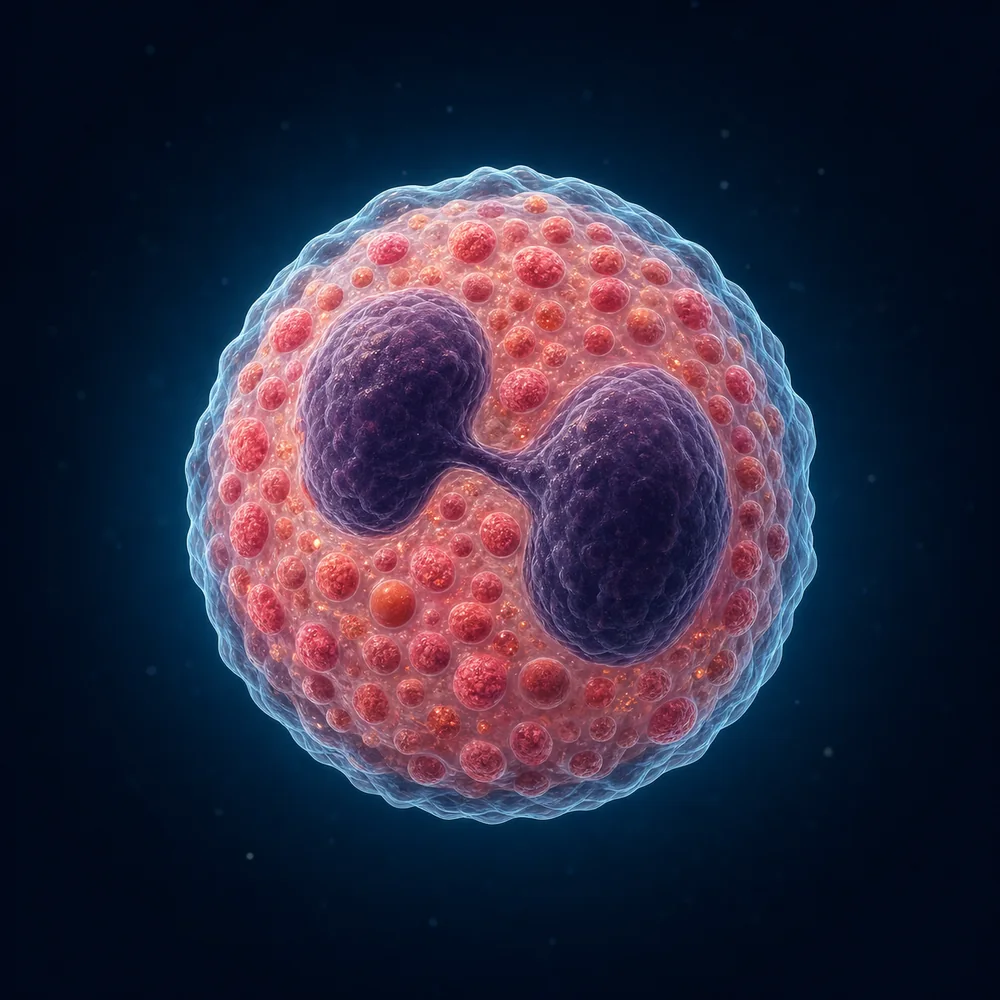 Educational illustration · not microscopy
Visual specimen
Eosinophil specimen
A type 2 tissue effector distinguished by a bilobed nucleus and coarse eosinophilic granules.
Look for
- Bilobed nucleus
- Coarse coral-red granules
- Distinct profile from mast cells and neutrophils
Illustration, not microscopy. Color and granule size are intentionally emphasized for teaching.
OpenAI-generated educational illustration under Atlas editorial direction · 2026-07-12
State signature
Systems profile
System effects
Primary mapped axes from existing Atlas data.
Tissue
Organ, barrier, stromal, vascular, or local niche behavior.
Inflammation
Inflammatory alarm, recruitment, mediator release, or tissue-damaging amplification.
Metabolism
Energy allocation, glycolysis, mitochondrial strain, lipid signaling, or nutrient-sensitive behavior.
Local map
Relationship field
Arrows point from the upstream source toward the receiving target. Restraint edges use a bar; association edges stay dashed because they are not causal arrows.
Selected relationship
Type 2 tissue amplification
Read as source produces or releases the target signal.
What this relationship means
Read this as output: Eosinophil can release IL-4, which then carries the next part of the signal.
Effect of source
Eosinophil is the producing cell or node.
Effect on target
IL-4 is the released mediator to follow downstream.
Use with caution
Release edges show possible biology, not measured patient levels.
System effect
Eosinophil releases IL-4; the mapped axes are inherited mainly from the released signal.
Inflammation
Inflammatory alarm, recruitment, mediator release, or tissue-damaging amplification.
Tissue
Organ, barrier, stromal, vascular, or local niche behavior.
Metabolism
Energy allocation, glycolysis, mitochondrial strain, lipid signaling, or nutrient-sensitive behavior.
Axes are mapped cues from Atlas data, not clinical predictions.
Evidence context
Curated edge, reviewed endpoints, and mapped external anchors.
Interleukin-4 and Interleukin-13 signaling
R-HSA-6785807 - checked 2026-06-28
Graph neighborhood
Direct relationships
Arrow shows upstream source toward receiving target.
Type 2 tissue amplification
Arrow shows upstream source toward receiving target.
Eosinophil maturation, survival, and tissue persistence
Network behavior
Systems Overview
Eosinophils are tissue-infiltrating granulocytes that release cationic granule proteins, lipid mediators, and cytokines in helminth defense, allergic inflammation, and remodeling.
Lineage
Origin
HSC -> granulocyte-monocyte progenitor -> eosinophil progenitor -> mature eosinophil
Transcription factors: GATA1, C/EBPα, PU.1
Lifecycle Visualizer
days
Marrow differentiation
IL-5-responsive granulopoiesis
hours
Circulation
Recruitable pool
days
Tissue activation
Granule and lipid mediator effector
days-weeks
Resolution or persistence
Apoptosis or chronic survival
Activation and Suppression
Surface and Secreted Signals
Metabolic State
Programs
Acute: IL-5 and eotaxin cues support recruitment, survival, and degranulation.
Chronic: Persistent epithelial alarmins and type 2 cytokines sustain remodeling and tissue injury.
Tissue Roles
gut: Baseline resident pools contribute to barrier tone and helminth defense.
lung: Airway eosinophilia drives mucus, bronchial reactivity, and epithelial injury.
skin: Participates in itch, dermatitis, and allergic tissue remodeling.
adipose: May support type 2 metabolic homeostasis in lean adipose niches.
Disease Associations
Clinical Pearls
- Eosinophilia points toward type 2 cytokine ecology, not just allergy.
- IL-5 controls survival and recruitment; IL-13 often explains tissue remodeling.
- Tissue eosinophils can be more clinically relevant than blood counts.