IMMUNE OS ATLASby AllerimSign in
← All journeys

03 · Barrier defense to resolution

How does the airway recruit neutrophils against a bacterial challenge?

Follow the airway ecosystem, CXCL8 recruitment signal, neutrophil response, and the balance between microbial defense and tissue injury.

9-13 minpublic educationno patient data
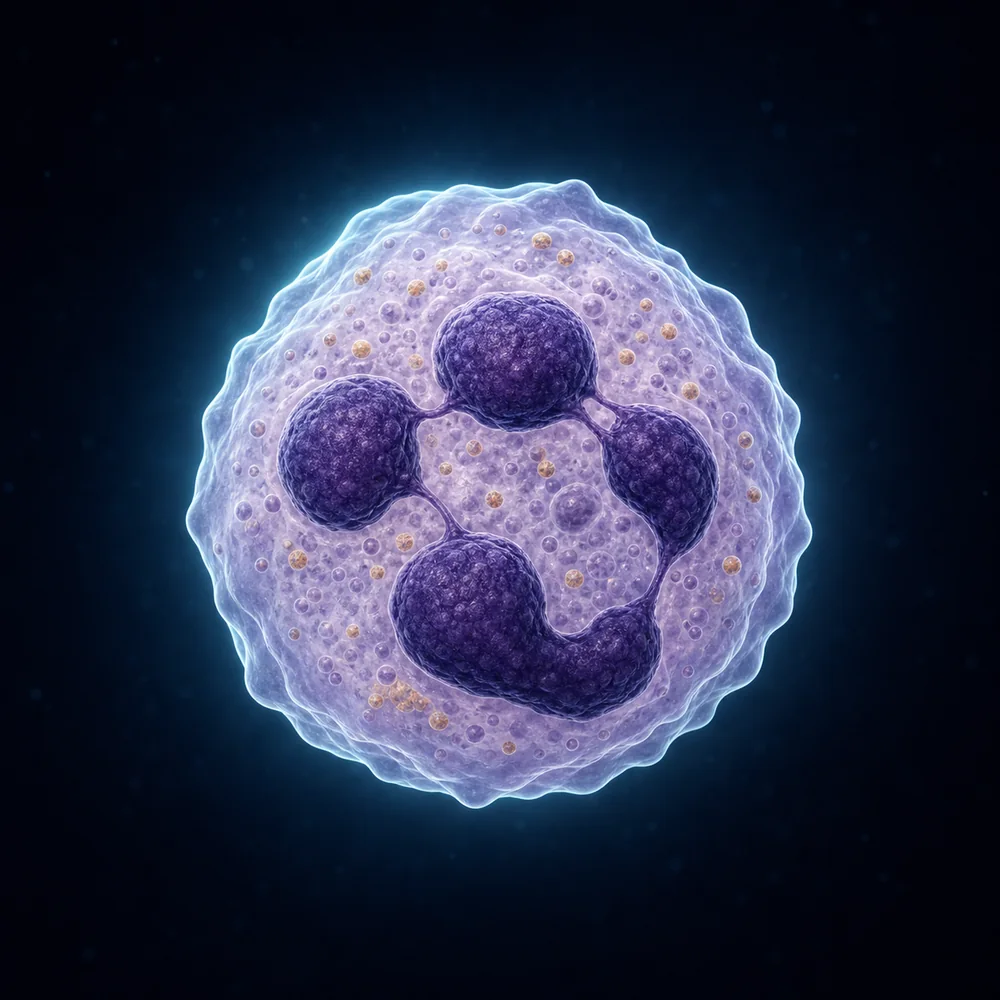
Educational illustration of a neutrophil with pale granular cytoplasm and a dark, segmented multilobed nucleus.
Educational illustration · not microscopy

Visual specimen

Neutrophil specimen

A short-lived innate responder identified by its segmented nucleus and fine antimicrobial granules.

Look for

  • Segmented multilobed nucleus
  • Fine cytoplasmic granules
  • Intact resting-to-ready membrane

Illustration, not microscopy. Granules and chromatin are emphasized for recognition and are not to scale.

OpenAI-generated educational illustration under Atlas editorial direction · 2026-07-12

Question to carry

How can the same rapid response protect tissue and also become damaging when amplified or prolonged?

Who this is for

A public innate-immunity journey for students, clinicians, and systems-biology learners.

Your journey progress

0 of 4 stops opened.

0% explored

Progress stays in this browser. Atlas records only deduplicated aggregate counters with no identifiers, free text, search terms, or patient data.

Follow the route

One connected story, 4 stops.

1

Locate the challenge

Lung immune ecosystem

Review airway barriers, resident sentinels, vascular recruitment routes, and the local conditions that shape an early response.

Boundary: Real infections vary by organism, site, host state, timing, and prior treatment.

Open stop
2

Follow recruitment

CXCL8 / IL-8

Inspect a major chemokine signal associated with neutrophil recruitment and activation in inflamed tissue.

Boundary: A recruitment signal is nonspecific and cannot diagnose a bacterial infection.

Open stop
3

Meet the responder

Neutrophil lifecycle

Trace marrow production, circulation, tissue recruitment, microbial killing mechanisms, and the need for timely clearance.

Boundary: Protective neutrophil functions and inflammatory tissue injury can coexist.

Open stop
4

Read the pattern

Neutrophilic bacterial archetype

Connect cells, cytokines, complement, tissue behavior, labs, and regulatory signals as a contextual defense pattern.

Boundary: The archetype is not an organism classifier, sepsis screen, or clinical prediction rule.

Open stop

What to take away

01

Airway defense begins with tissue sensing and coordinated recruitment.

02

Neutrophils use multiple antimicrobial mechanisms rather than one linear pathway.

03

Resolution and clearance matter because prolonged activation can injure host tissue.

Educational boundary

This journey is not an infection diagnosis, severity assessment, or triage tool. Severe respiratory symptoms or suspected serious infection require appropriate clinical evaluation.

Evidence record

Versioned and source-anchored

Reviewed 2026-07-12 · Atlas editorial baseline

Owner Mark Pruitt · next review 2026-08-12 · stale on 2026-09-12

v1.0source anchoredreviewhigh stakescurrent

Known uncertainty

Bacterial response patterns differ by organism, tissue compartment, immune state, age, medication, and timing.

The journey does not distinguish bacterial from viral or noninfectious inflammation in an individual.

Atlas Professional

Open a protected response trace

Atlas Professional contains organism- and tissue-context response traces with containment, amplification, and failure branches.

Request professional access